AIDealsPro is reader-supported. Some links on this page are affiliate links: if you buy through them we may earn a commission at no extra cost to you. It never changes our verdicts. How we review: https://aidealspro.com/how-we-review/
Best for: video narration, audiobooks, course voiceovers, and podcasts — anywhere a natural long-form read matters.
Not for: real-time conversational AI on a basic plan (billed separately per minute), or anyone needing a commercial license for free.
Starting price: $6/month (Starter, commercial license included — checked Oct 2026).
Table of Contents
What is ElevenLabs?
ElevenLabs is an AI voice platform: text-to-speech in 70+ languages, instant and professional voice cloning, a library of community voices, dubbing, and sound effects. Its models are known for natural prosody — the rhythm and emphasis that make narration sound human rather than robotic. It serves creators, publishers, and developers via web app and API. This ElevenLabs review covers the real pricing, the character math nobody explains, and the free plan’s hard limits.
Pricing: what ElevenLabs costs (checked Oct 2026)
ElevenLabs bills in characters (roughly 800–900 characters per minute of speech). Figures below in USD, from the official pricing page.
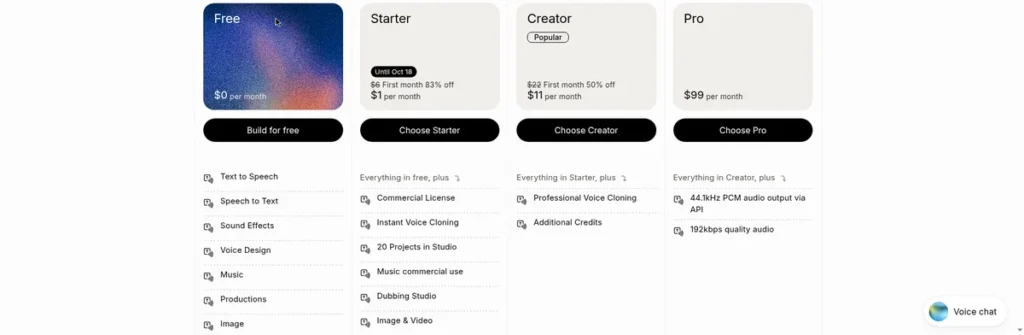
| Plan | Price | Characters/month | For |
|---|---|---|---|
| Free | $0 | 10,000 (~10 min) | Testing voices |
| Starter | $6/month | 30,000 (~30 min) | Solo creators, commercial license |
| Creator | $22/month | 121,000 (~121 min) | Regular publishers |
| Pro | $99/month | 600,000 (~600 min) | Teams, audiobooks |
| Scale | $330/month | 2,000,000+ | High-volume production |
| Business | Custom | Custom | Enterprise, SSO |
Annual billing takes two months off every plan. Prices in USD — confirm at checkout.
The character math nobody explains
Convert characters to your actual output before choosing a plan:
| Your output | Characters needed | Fits in | Monthly cost |
|---|---|---|---|
| 4 videos × 10 min/month | ~36,000 | Creator (121,000) | $22 |
| 1 audiobook chapter/week (~60 min) | ~54,000 | Creator (121,000) | $22 |
| Daily 10-min videos (30/month) | ~270,000 | Pro (600,000) | $99 |
| Occasional 5-min video | ~4,500 | Free (10,000) | $0 — but no commercial license |
The rule: budget 1.5x your published volume (rewrites and re-renders consume characters too), then pick the cheapest plan that covers it.
What the free plan really gives you
10,000 characters a month (~10 minutes), access to the voice library, and voice cloning to try. The hard limits: attribution required, non-commercial use only, and lower-quality tiers. It answers “does the voice sound right for my content” — it does not cover monetized videos. The $6 Starter plan is the real entry point: 30,000 characters plus the commercial license.
Voice cloning: how it works
Two tiers. Instant cloning (Starter and up) needs a few minutes of clean audio and works in minutes — fast but less accurate. Professional cloning needs more audio and a verification step, producing a closer match. Only clone voices you own or have explicit permission to use. ElevenLabs requires verification for cloning, which is the safeguard that matters.
Podcast workflow: script to MP3
The long-form loop that podcasters actually use:
- Write the script in sections (intro, segments, outro) — 20 minutes of audio is roughly 18,000 characters.
- Paste section by section into a Project (long-form organization), not one giant generation.
- Pick your voice and generate each section; re-render only the sections with mispronunciations.
- Download the audio and assemble in your editor with music and ads.
Section-by-section generation is the key habit: it isolates re-renders so one bad paragraph does not cost a full re-generation.
Dubbing: how it works
Upload a video or audio file, select target languages from the 70+ supported, and ElevenLabs produces translated audio with timing preserved to the original. The use case: one YouTube video dubbed into five languages without re-recording. Dubbing consumes characters like standard generation — budget it the same way (900 characters per minute, per language).
Voice library and revenue sharing
The voice library lets you use community-created voices — and publish your own. Creators who share voices can earn revenue when others use them. For channels, the library is a shortcut to a distinctive narrator without cloning; for voice owners, it is a small income stream. Test library voices with your actual script before committing — a voice that sounds great on a demo may not fit your content.
Key features (from the official site and docs)
- Text-to-speech in 70+ languages with natural prosody.
- Instant voice cloning (Starter+) and professional cloning (higher tiers).
- Voice library: community voices with revenue sharing for creators.
- Dubbing: translate audio/video while preserving timing.
- Sound effects generation and API access for developers.
Feature availability varies by plan — check the official pricing page.
Monthly output per plan
In finished audio minutes (at ~900 characters/min): Free ~11 min, Starter ~33 min, Creator ~134 min, Pro ~660 min. A weekly 20-minute podcast (~80 min/month with intros) fits Creator comfortably; a daily show needs Pro.
Starter vs Creator: the $16 decision
- Under ~30 min audio/month: Starter $6 — cheapest commercial license.
- 30–130 min: Creator $22 — the regular-publisher tier.
- 130–600 min: Pro $99 — audiobooks, daily shows.
Most solo creators land on Creator. Starter is for testing commercial waters — the moment you publish regularly, the 30,000-character ceiling arrives fast.
Audiobook production: the full math
A 10-hour audiobook is roughly 540,000 characters (10 hours × 60 minutes × 900 characters). That fits inside Pro’s 600,000 — one book a month, with re-renders tight. Two books a month needs Scale ($330).
- 1 book/month (10h): ~540,000 characters → Pro $99.
- 2 books/month: ~1,080,000 characters → Scale $330.
- Occasional chapter: ~54,000 characters → Creator $22.
Narrators should also budget proof-listening time — AI narration still needs a human ear pass for mispronunciations, especially names and technical terms.
API: when the web app isn’t enough
ElevenLabs has an API for developers — apps, automations, dynamic voice responses. API usage is billed separately from the web-app subscription plans above, with its own pricing. If you are building a product on ElevenLabs voices, price the API independently; the character tables in this review describe the web plans, not API rates.
The 70+ languages: what actually varies
Language count is not language quality. High-resource languages (English, Spanish, French, German, Hindi/Urdu among major ones) get the most natural prosody; lower-resource languages can sound flatter. The practical move: generate the same test paragraph in your target language on the free tier and listen before subscribing — especially for dubbing work, where unnatural emphasis is most obvious. Voice quality also differs between standard and premium voice models on the same language.
Monitoring usage: the character dashboard
ElevenLabs shows character consumption per project in the dashboard — check it weekly in your first month. The pattern most creators discover: re-renders consume 30–50% of the allowance, not the final audio. That is why the 1.5x budgeting rule in this review exists. If you consistently end the month under 50% usage, downgrade; if you hit the ceiling, the next tier is cheaper than the frustration.
Annual billing takes two months off every plan — but only commit annually once you know your tier. The expensive mistake is annual Pro when Creator would have sufficed; the cheap insurance is one monthly cycle first. Your dashboard history after 30 days is the only honest advisor here.
Pros and cons
Pros
- Best-in-class natural prosody for long-form narration.
- Commercial license from just $6/month.
- Generous free tier for testing (10,000 characters, no card).
- 70+ languages plus dubbing in one platform.
- API and voice library for developers and publishers.
Cons
- Free tier forbids commercial use and requires attribution.
- Character billing confuses minute-based planners — you must convert.
- Professional cloning needs significant clean audio and verification time.
- Conversational AI (real-time agents) bills separately per minute, not from your character pool.
- High-volume pricing jumps steeply ($99 → $330).
Who should NOT use ElevenLabs
- Anyone wanting free commercial voiceover — the free tier forbids it. Cheapest legal path is Starter at $6.
- Teams needing real-time voice agents on a basic plan — that is separate per-minute billing.
- Creators who need only occasional short clips — the free tier may already be enough for drafts.
- Anyone expecting perfect pronunciation of niche terms without tweaking — phonetic spelling and retries are part of the workflow.
Making the voice less robotic
Three adjustments that matter more than the voice choice itself:
- Tune stability and similarity settings — lower stability adds expressiveness (and occasional instability); find your voice’s sweet spot with short tests.
- Punctuate for speech, not for print — commas and ellipses control pauses; break long sentences.
- Spell out problem words phonetically — names, brands, and technical terms often need a respelling pass.
These three habits close most of the gap between “obvious AI” and “sounds human.”
Alternatives
For video-first creators who need voices inside an editor: check our AI voice tools hub / For avatar video with built-in voices: our HeyGen review and comparison HeyGen vs Synthesia
Frequently asked questions
How much does ElevenLabs cost?
Free (10,000 characters/month), Starter $6/month (30,000), Creator $22/month (121,000), Pro $99/month (600,000). Annual billing takes two months off. Checked Oct 2026.
Is ElevenLabs free for commercial use?
No — the free tier requires attribution and forbids commercial use. The commercial license starts with the $6 Starter plan.
How many characters do I need per video?
Roughly 800–900 per minute of speech. A 10-minute video needs ~9,000 characters; budget 1.5x for rewrites.
How does voice cloning work?
Instant cloning (Starter+) from a few minutes of audio; professional cloning needs more audio plus verification. Only clone voices you own or have permission to use.
Which ElevenLabs plan do I need for audiobooks?
One 60-minute chapter a week is ~54,000 characters/month — Creator ($22) covers it. A full book at pace needs Pro ($99).
Does ElevenLabs do real-time voice agents?
Yes, conversational AI is available — but billed separately per minute, not from your character allowance. Price it independently.
Can I sell voiceovers made with ElevenLabs to clients?
Yes on paid plans — the commercial license covers client work. For broadcast, resale, or platform redistribution edge cases, check the current plan terms.
What languages does ElevenLabs support?
70+ languages for text-to-speech plus dubbing. Quality varies by language — test your target language on the free tier before subscribing.
How do projects work for long content?
Use Projects (not single generations) for anything long-form: they organize multi-section content so you can re-render one chapter without regenerating the whole piece.
What’s the difference between instant and professional cloning?
Instant cloning (Starter+) needs a few minutes of audio and works in minutes — fast but less accurate. Professional cloning needs more audio plus verification, producing a closer match to the original voice.
Last updated 9 Oct 2026. Prices checked on the official pricing page in Oct 2026 — confirm at checkout. Category hub: https://aidealspro.com/ai-voice-tools/

The AIDealsPro team reads the official pricing and docs for every tool we cover and re-checks prices monthly.
How we review